
Mastering Dumbbell Lunges: Transform Your Lower Body Strength and Athletic Performance
The gym floor becomes a stage for transformation when an athlete commits to mastering fundamental movements. Among the arsenal of lower body exercises, dumbbell lunges stand as a cornerstone movement that builds functional strength, enhances balance, and sculpts powerful legs. This dynamic exercise combines precision, control, and raw determination—qualities embodied in every focused rep performed under the natural light of a well-designed training space.
The Power of Dumbbell Lunges in Modern Fitness
Dumbbell lunges represent more than just another leg exercise—they’re a comprehensive movement pattern that challenges your body in multiple planes of motion. Unlike stationary exercises, lunges demand coordination between strength, stability, and spatial awareness, making them invaluable for athletes and fitness enthusiasts alike.
When performed with proper form, this unilateral exercise targets the quadriceps, hamstrings, glutes, and calves while simultaneously engaging your core for balance. The addition of dumbbells intensifies the challenge, increasing muscular activation and promoting symmetrical development between both legs.
Breaking Down the Perfect Lunge Technique
Executing dumbbell lunges with precision requires attention to several critical form elements. The starting position begins with feet hip-width apart, dumbbells held at your sides with a neutral grip. As you step forward, your front knee should track over your toes without extending past them, while your back knee lowers toward the ground in a controlled descent.
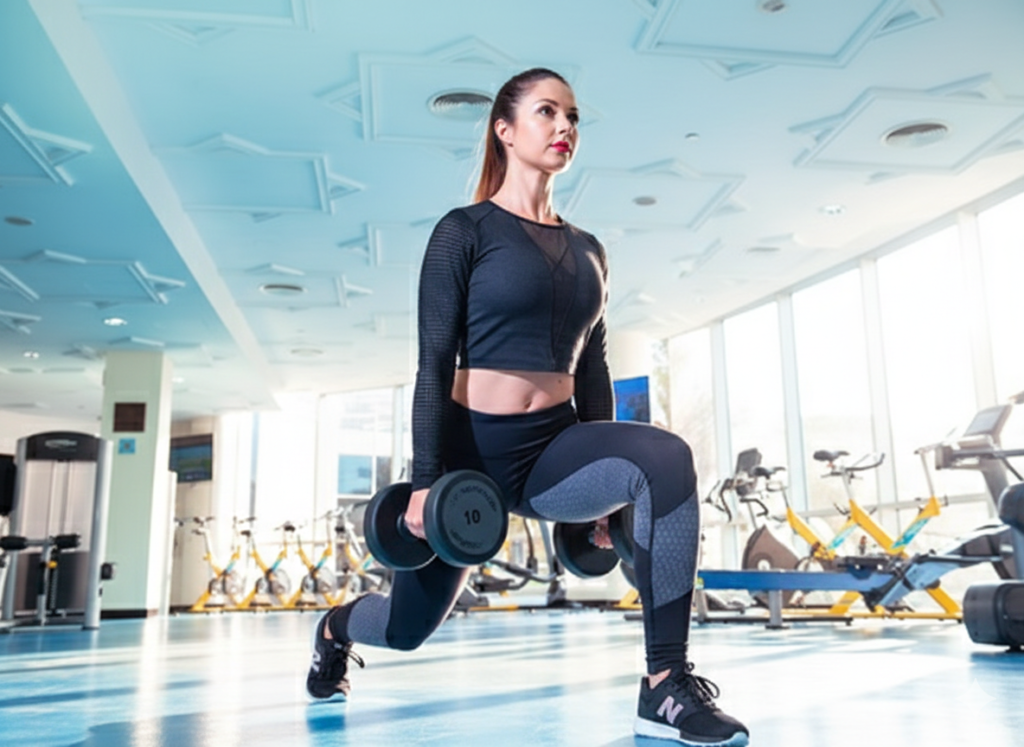
The athletic woman captured in high-resolution fitness photography demonstrates the ideal posture: upright torso, engaged core, and eyes focused forward. This alignment isn’t merely aesthetic—it’s biomechanically essential for protecting your joints and maximizing muscle recruitment throughout the movement.
Creating the Ideal Training Environment
The atmosphere surrounding your workout significantly impacts performance and consistency. Bright, naturally lit gym spaces with large windows don’t just look appealing—they provide tangible psychological and physiological benefits. Natural light exposure during exercise has been linked to improved mood, enhanced vitamin D production, and better circadian rhythm regulation.
A well-equipped gym environment featuring modern equipment, ample space for movement, and proper ventilation creates the foundation for focused training sessions. When your surroundings inspire rather than distract, every lunge becomes an opportunity for growth rather than an obligation to endure.
Muscle Activation and Movement Dynamics
The beauty of dumbbell lunges lies in their comprehensive muscle engagement pattern. During the eccentric phase—the lowering portion—your quadriceps work to control the descent while your glutes and hamstrings prepare for the concentric drive back to standing. This controlled movement under load stimulates muscle fiber recruitment that translates directly to improved athletic performance.
High-resolution photography captures the subtle details of muscle activation: the defined separation in the quadriceps, the engagement through the glute complex, and the stabilizing tension in the core. These visual cues serve as valuable feedback mechanisms for athletes refining their technique and understanding their body’s response to training stimulus.
Progressive Overload Strategies for Lunges
Advancing your lunge performance requires strategic progression beyond simply adding weight. You can manipulate tempo, increasing time under tension by slowing the eccentric phase to three or four seconds. Alternatively, experiment with deficit lunges by elevating your front foot, or challenge stability with walking lunges that demand dynamic balance.
The focused expression captured in dynamic fitness photography reflects the mental engagement required for progressive training. Each variation presents unique challenges that keep your nervous system adapting and your muscles responding with continued growth and strength development.
Functional Benefits Beyond Aesthetics
While sculpted legs certainly appeal to many fitness enthusiasts, the functional benefits of dumbbell lunges extend far beyond appearance. This movement pattern mimics everyday activities like climbing stairs, stepping over obstacles, and recovering balance—making it exceptionally practical for real-world strength application.
Athletes across disciplines incorporate lunges for sport-specific conditioning. Runners develop single-leg power for propulsion, basketball players enhance their defensive stance mobility, and general fitness practitioners build the foundation for injury prevention through balanced lower body development.
Integrating Lunges Into Your Training Program
Strategic programming determines whether dumbbell lunges become a transformative element in your routine or just another exercise to check off. For hypertrophy goals, consider 3-4 sets of 8-12 repetitions per leg with moderate weight and controlled tempo. Strength-focused athletes might perform 4-5 sets of 5-6 reps with heavier loads and full recovery periods.
The positive vibe of a bright, refreshing gym space naturally encourages consistency—the true driver of long-term results. When your training environment motivates you to show up, and your exercise selection delivers measurable progress, sustainable fitness becomes achievable rather than aspirational.
Common Mistakes and Correction Strategies
Even experienced lifters occasionally fall into technical errors with lunges. Forward knee cave, excessive forward lean, and rushing through repetitions all diminish exercise effectiveness while increasing injury risk. The solution lies in reducing load, slowing tempo, and prioritizing movement quality over quantity.
Recording your sets or training in front of mirrors provides immediate visual feedback—similar to studying high-resolution fitness photography of proper form. This awareness creates the neuromuscular connection necessary for automatic, correct movement patterns that persist even when fatigue sets in during challenging workouts.
The Mind-Muscle Connection in Lower Body Training
The intense focus visible in professional fitness photography illustrates a crucial but often overlooked training principle: the mind-muscle connection. Consciously directing attention to the working muscles during each repetition enhances activation and improves training outcomes beyond mechanical execution alone.
During dumbbell lunges, mentally cueing glute engagement at the bottom position and quadricep activation during the ascent transforms a physical exercise into a focused practice. This intentional approach to training accelerates progress while deepening your understanding of how your body moves and responds.
Building a Complete Lower Body Foundation
Dumbbell lunges shine brightest when integrated into a comprehensive lower body program alongside complementary exercises. Compound movements like squats and deadlifts provide foundational strength, while isolation work targeting specific muscle groups addresses individual weaknesses and aesthetic goals.
The balanced approach reflected in well-rounded training programs mirrors the balanced development achieved through unilateral exercises like lunges. By addressing both legs independently, you eliminate strength imbalances and create symmetrical development that enhances both performance and appearance.
Conclusion: Commitment to Excellence Through Movement
Excellence in fitness emerges from the intersection of proper technique, consistent effort, and an environment that supports your goals. Dumbbell lunges exemplify how fundamental movements, when executed with focus and progressive intention, deliver transformative results that extend beyond the gym floor into every aspect of physical capability.
The vibrant training spaces filled with natural light, modern equipment, and positive energy serve as daily reminders that fitness represents an investment in yourself—one rep, one set, one workout at a time. Whether you’re pursuing athletic performance, aesthetic goals, or functional strength, mastering movements like dumbbell lunges provides the foundation for sustained progress and lifelong physical capability.